
Guidebook lists the title for this panel as TOKYOPOP – Past, Present & Future. It seemed to me that the “Past” part was mostly an apologia for the company’s shutdown in 2011, and possibly to build up credibility for the idea that Tokyopop has a future given where they presently are.
I tried to get pictures of some of the slides just to be sure I wasn’t misrepresenting anything that was said, but smartphone photos from the back of the room aren’t the greatest. Sorry about that.
Past
Stu Levy was actually at the mike for the panel to introduce himself to the audience and do most of the talking (at least in the beginning). He had an introductory slide claiming, (on the first line of his bio) “Born in LA (1967), old-school geek cred.” He claimed that “[w]e had sort of the Myspace of manga before Facebook was even around,” which sounded like he was trying to sell the story of Tokyopop-as-innovator, but ended up sounding like a desperate attempt to claim credit for something they didn’t pull off successfully.
In regards to the shutdown, Stu argued that there were a number of causes: 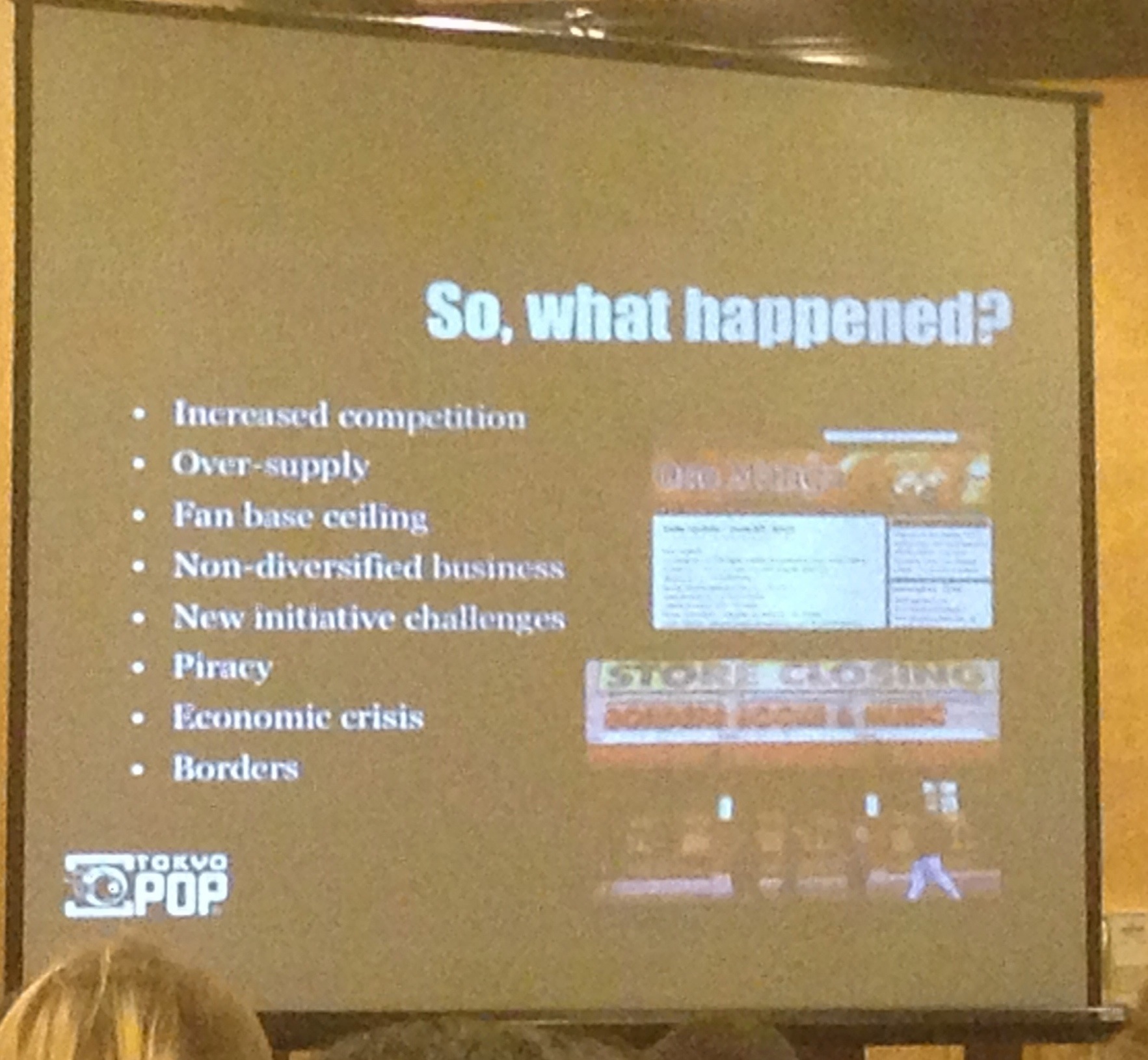
Discussion was focused on the last 3: the effect of the economic crisis was that Tokyopop went from a staff 90 people to 35 in a single day. With regards to scanlations, Stu didn’t seem to be interested in assigning blame: he admitted to reading them himself as a lead-in to asking for a show of hands from audience members who also read scanlations. He went on to pose the challenge that had stumped Tokyopop as well as other publishers: how do you sell a volume of manga to somebody who’s already read it digitally?
The greatest single factor that lead to Tokyopop’s closure was the end of Borders. According to Stu, Borders owed Tokyopop 7 figures when they shut down (they owed big publishers like Random House about $40M). The issue was ultimately about a cash flow crunch, coupled with the inability to find investors in a bad economy; excess debt was NOT an issue – as Stu pointed out “Tokyopop never went bankrupt.”
Stu also explained how Tokyopop as we knew it was done for even before the Tohoku quake; he had to travel to Japan to tell publishers there that Tokyopop would no longer be able to publish their titles. The trip was on March 9, 2011, the meetings were on the 10th, and the earthquake on the 11th, so it wasn’t a factor in the decision to shut down Tokyopop.
Present and Future
Because Tokyopop shut down rather than going bankrupt, it still exists as a “virtual company”. Once they got through 2011 they could start working on what they hoped would lead to the revival of TP; they mentioned (and pushed) the newsletter run by Nerdist: 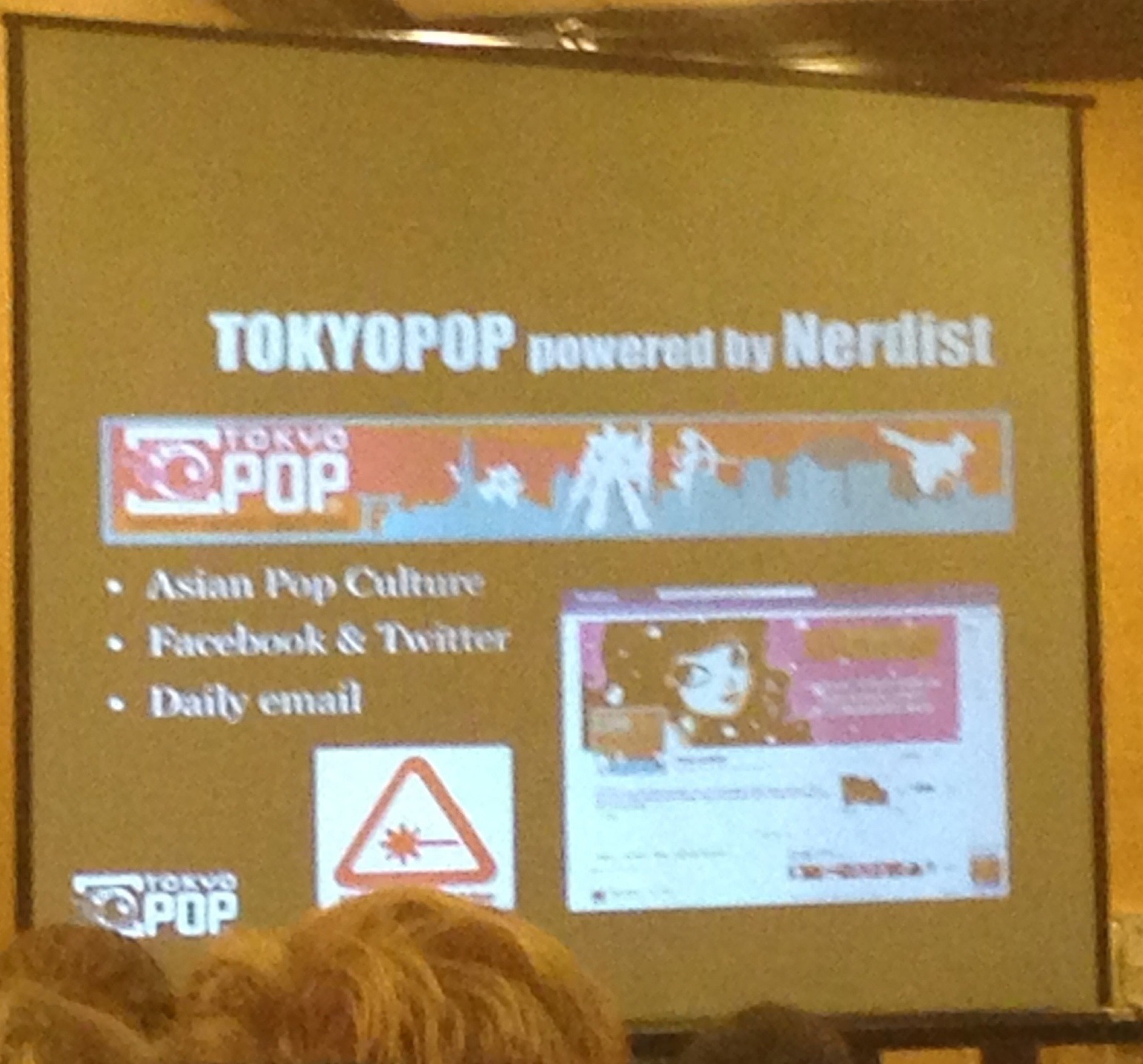
They also mentioned that there was a new Tokyopop website as of today (Sunday, Jan 6 2013); the site had been in development through the Friday night prior (1/4). Suggestions or requests for improvement can be send to info@tokyopop.com.
In terms of additional net presence, they’re looking at relaunching their Youtube channel in about a month and a half, probably partnering with Nerdist on that just as on their newsletter.
That’s all well and good, but what about the product people most associated with Tokyopop: manga? Stu discussed trying to continue manga via Print on Demand (POD), ebooks, and Kickstarter, but the first point he made was that there were rights issues that had to be solved first – when Tokyopop shut down back in 2011, they had to basically surrender publication rights back to the Japanese publishers. Getting rights back or getting rights to new series was difficult because relations with Japanese publishers were tricky now – they’d been stung once, and weren’t eager to take any more chances. Stu said that their best relationship at the moment was with Hetalia’s publisher Gentosha; discussions with them regarding Hetalia 4 and 5 were ongoing.
The manga portion is also where Stu brought co-panelist Daniela Orihuela-Gruber into the conversation. They discussed how Rightstuf had approached Tokyopop to start POD, and they talked about publishing digitally via Comixology (tried to measure support for the idea by taking pictures of a before-and-after show of hands: who uses Comixology now, vs. who would use it if Tokyopop manga were available there). It sounded like digital publishing would cover Bizenghast and other OEL titles as well as manga; more precisely, it sounded like discussions were ongoing and things weren’t settled yet.
Daniela fielded a few questions about manga in particular: what about cancelled series, will other series be brought back, and what about any new series? In regards to cancelled series – they’d be slow to be brought back, because as Stu mentioned negotiations with publishers would be needed for each title. In addition, licensing discontinuing or new series was dependent on Tokyopop finding some way to see there’s a demand for the title. Stu interjected that they were thinking about using Kickstarter in that role. When I asked how that would work, the process Stu described was that Tokyopop would get title requests from fans. They’d then go talk to publishers, and get the publisher’s permission to post a Kickstarter for that title, along with a commitment from the publisher to license the title to TP if the Kickstarter succeeds. Stu cited Digital Manga’s success with their Tezuka manga Kickstarter projects (as examples of how the process would work, and of its viability).
They also discussed a couple other things they were working on (some already mentioned above).
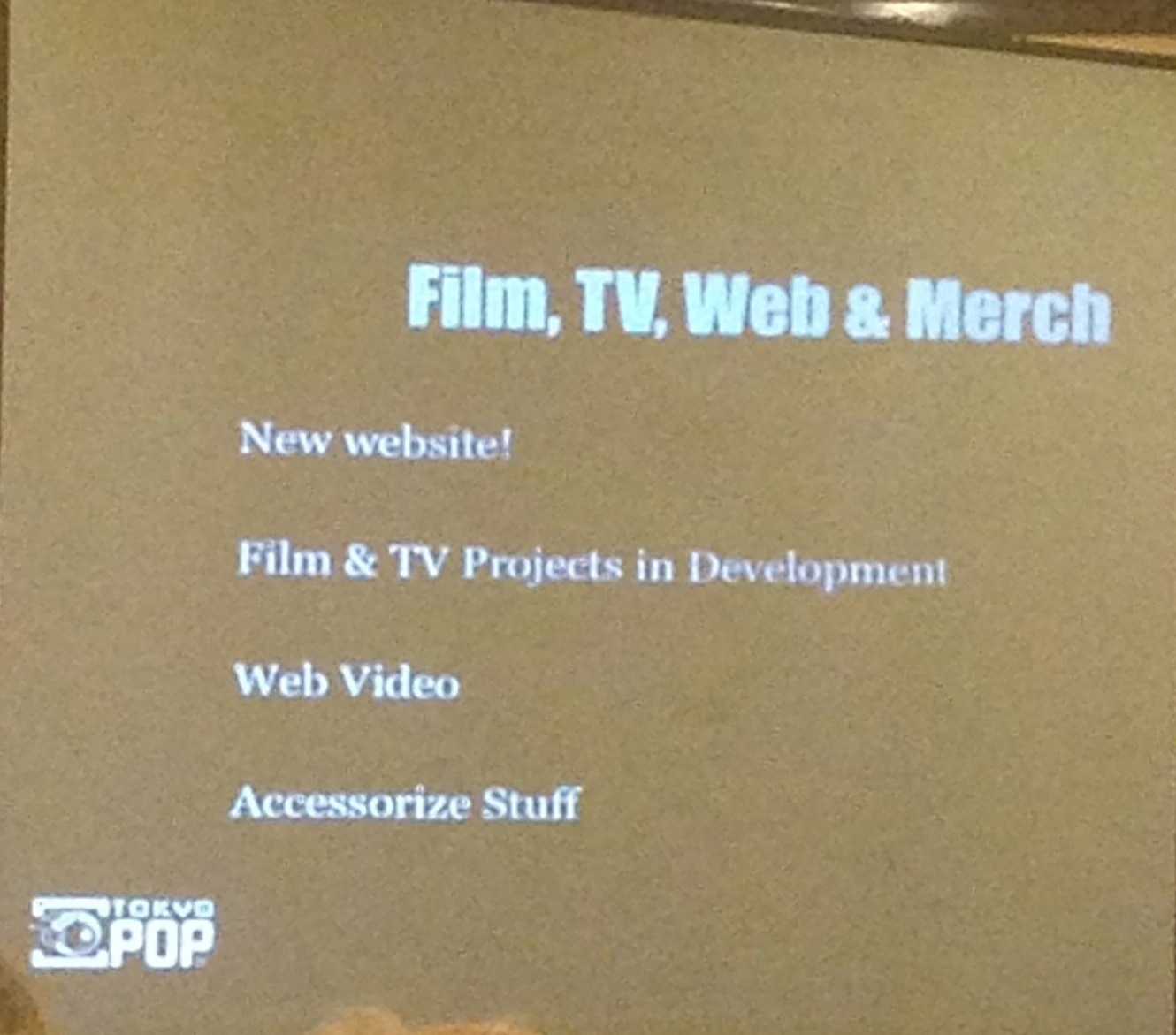
They’re offering merchandise through CafePress. There’s a small boutique of items at the moment, but mentioned that they’d be happy if fans sent in any ideas for new items.
Film and TV projects would most likely be OEL, though they do have those rights for a very few Japanese series. Stu acknowledged that OEL titles mostly didn’t sell very well, but he said that film companies and TV networks saw story potential in some of them (he didn’t provide any specific titles).
And that was pretty much it for the presentation. After that they went to trivia for prizes and Q&A, but I had to leave at that point.
 Percent Liar