AnimeLA con report part 3 – Tokyopop panel

Guidebook lists the title for this panel as TOKYOPOP – Past, Present & Future. It seemed to me that the “Past” part was mostly an apologia for the company’s shutdown in 2011, and possibly to build up credibility for the idea that Tokyopop has a future given where they presently are.

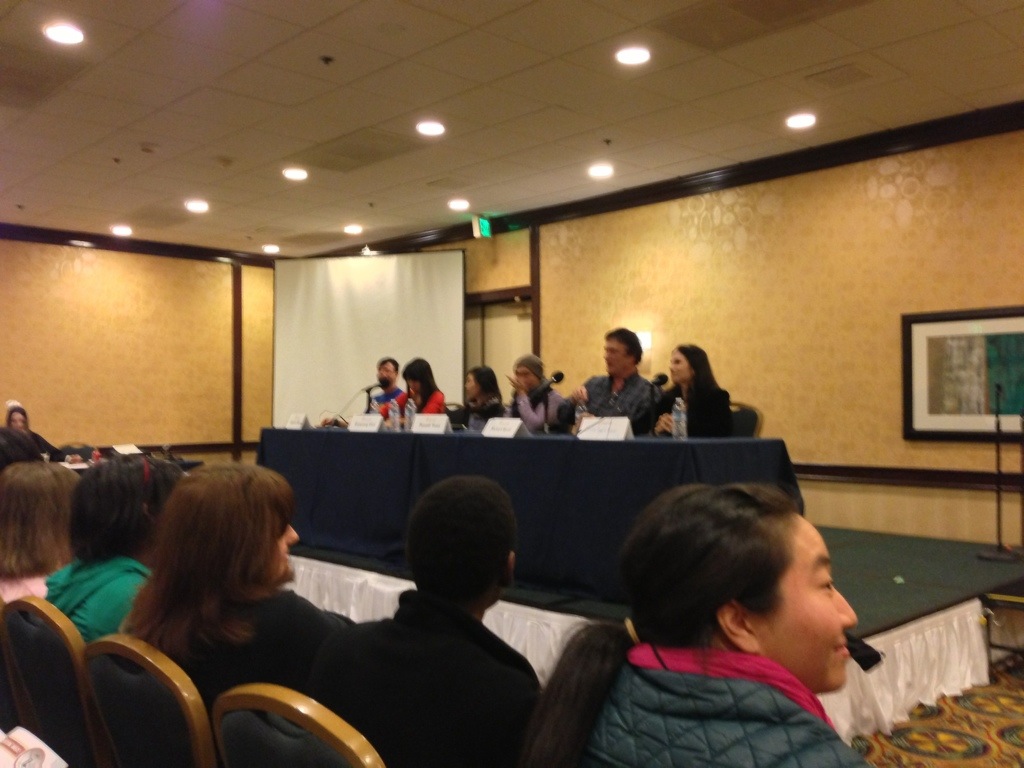
I tried to get pictures of some of the slides just to be sure I wasn’t misrepresenting anything that was said, but smartphone photos from the back of the room aren’t the greatest. Sorry about that.

Past
Stu Levy was actually at the mike for the panel to introduce himself to the audience and do most of the talking (at least in the beginning). He had an introductory slide claiming, (on the first line of his bio) “Born in LA (1967), old-school geek cred.” He claimed that “[w]e had sort of the Myspace of manga before Facebook was even around,” which sounded like he was trying to sell the story of Tokyopop-as-innovator, but ended up sounding like a desperate attempt to claim credit for something they didn’t pull off successfully.

In regards to the shutdown, Stu argued that there were a number of causes: 20130216-135532.jpg
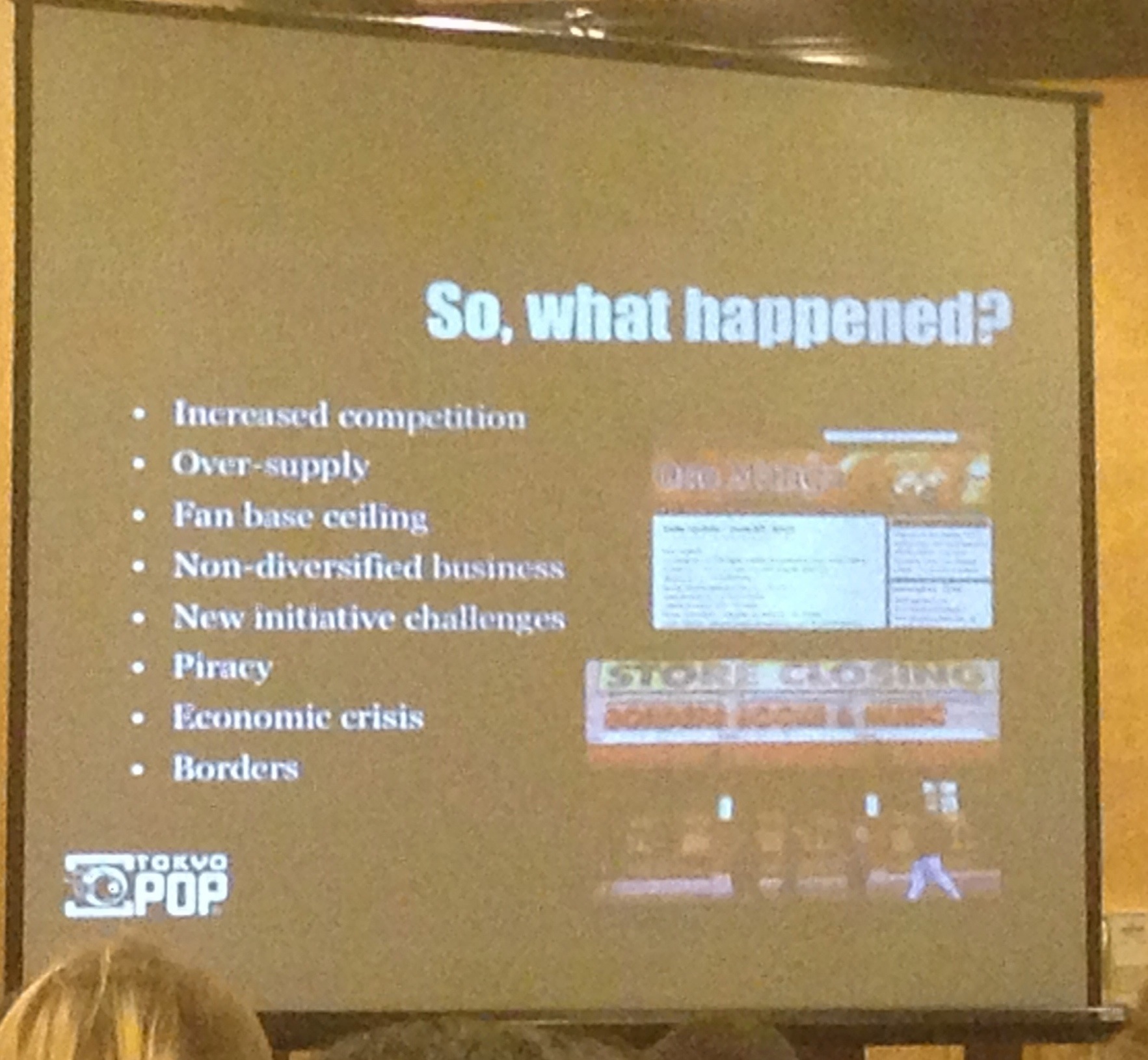
Discussion was focused on the last 3: the effect of the economic crisis was that Tokyopop went from a staff 90 people to 35 in a single day. With regards to scanlations, Stu didn’t seem to be interested in assigning blame: he admitted to reading them himself as a lead-in to asking for a show of hands from audience members who also read scanlations. He went on to pose the challenge that had stumped Tokyopop as well as other publishers: how do you sell a volume of manga to somebody who’s already read it digitally?

The greatest single factor that lead to Tokyopop’s closure was the end of Borders. According to Stu, Borders owed Tokyopop 7 figures when they shut down (they owed big publishers like Random House about $40M). The issue was ultimately about a cash flow crunch, coupled with the inability to find investors in a bad economy; excess debt was NOT an issue – as Stu pointed out “Tokyopop never went bankrupt.”

Stu also explained how Tokyopop as we knew it was done for even before the Tohoku quake; he had to travel to Japan to tell publishers there that Tokyopop would no longer be able to publish their titles. The trip was on March 9, 2011, the meetings were on the 10th, and the earthquake on the 11th, so it wasn’t a factor in the decision to shut down Tokyopop.

Present and Future
Because Tokyopop shut down rather than going bankrupt, it still exists as a “virtual company”. Once they got through 2011 they could start working on what they hoped would lead to the revival of TP; they mentioned (and pushed) the newsletter run by Nerdist: 20130216-141816.jpg
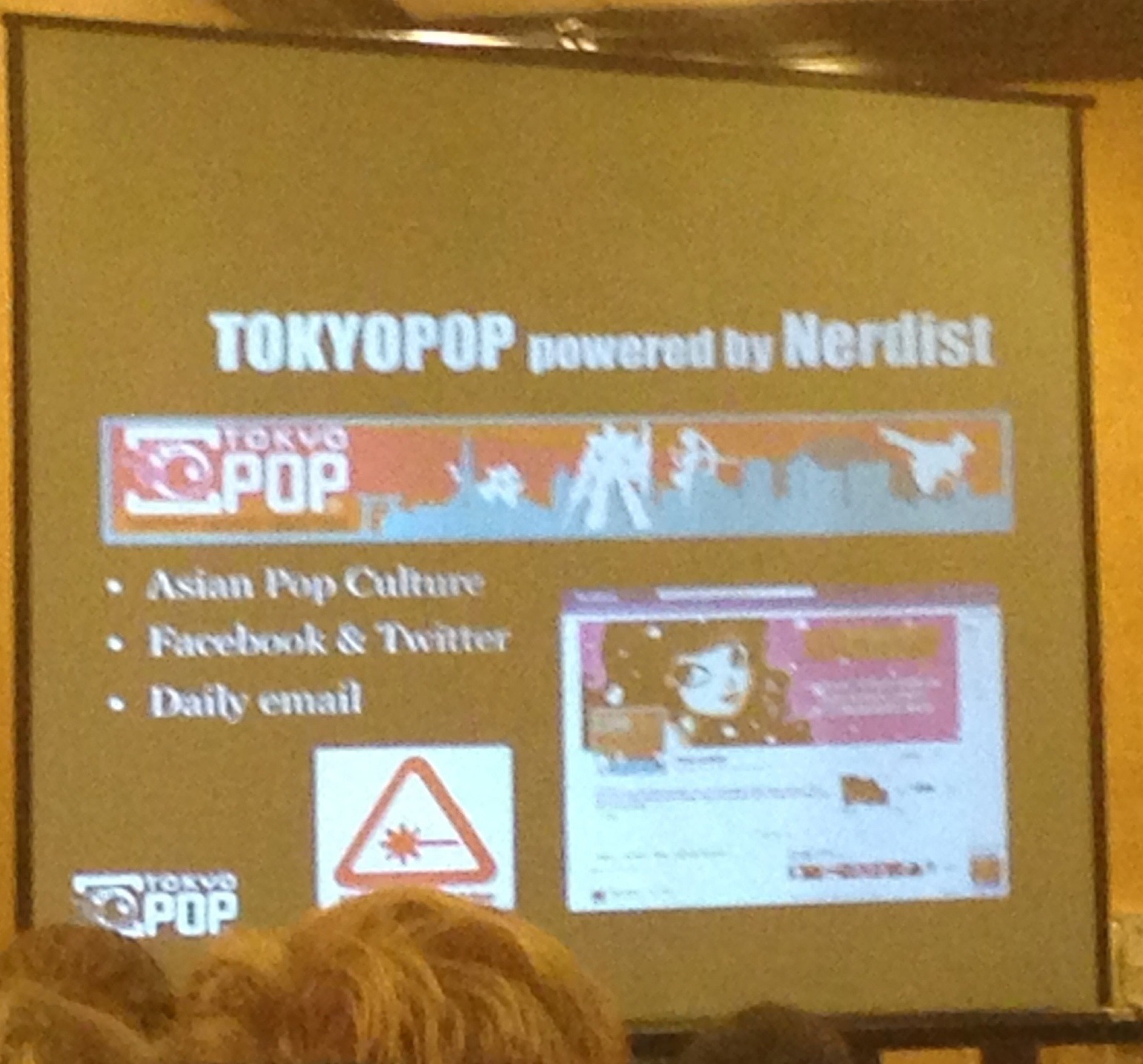
They also mentioned that there was a new Tokyopop website as of today (Sunday, Jan 6 2013); the site had been in development through the Friday night prior (1/4). Suggestions or requests for improvement can be send to info@tokyopop.com.

In terms of additional net presence, they’re looking at relaunching their Youtube channel in about a month and a half, probably partnering with Nerdist on that just as on their newsletter.

That’s all well and good, but what about the product people most associated with Tokyopop: manga? Stu discussed trying to continue manga via Print on Demand (POD), ebooks, and Kickstarter, but the first point he made was that there were rights issues that had to be solved first – when Tokyopop shut down back in 2011, they had to basically surrender publication rights back to the Japanese publishers. Getting rights back or getting rights to new series was difficult because relations with Japanese publishers were tricky now – they’d been stung once, and weren’t eager to take any more chances. Stu said that their best relationship at the moment was with Hetalia’s publisher Gentosha; discussions with them regarding Hetalia 4 and 5 were ongoing.

The manga portion is also where Stu brought co-panelist Daniela Orihuela-Gruber into the conversation. They discussed how Rightstuf had approached Tokyopop to start POD, and they talked about publishing digitally via Comixology (tried to measure support for the idea by taking pictures of a before-and-after show of hands: who uses Comixology now, vs. who would use it if Tokyopop manga were available there). It sounded like digital publishing would cover Bizenghast and other OEL titles as well as manga; more precisely, it sounded like discussions were ongoing and things weren’t settled yet.

Daniela fielded a few questions about manga in particular: what about cancelled series, will other series be brought back, and what about any new series? In regards to cancelled series – they’d be slow to be brought back, because as Stu mentioned negotiations with publishers would be needed for each title. In addition, licensing discontinuing or new series was dependent on Tokyopop finding some way to see there’s a demand for the title. Stu interjected that they were thinking about using Kickstarter in that role. When I asked how that would work, the process Stu described was that Tokyopop would get title requests from fans. They’d then go talk to publishers, and get the publisher’s permission to post a Kickstarter for that title, along with a commitment from the publisher to license the title to TP if the Kickstarter succeeds. Stu cited Digital Manga’s success with their Tezuka manga Kickstarter projects (as examples of how the process would work, and of its viability).

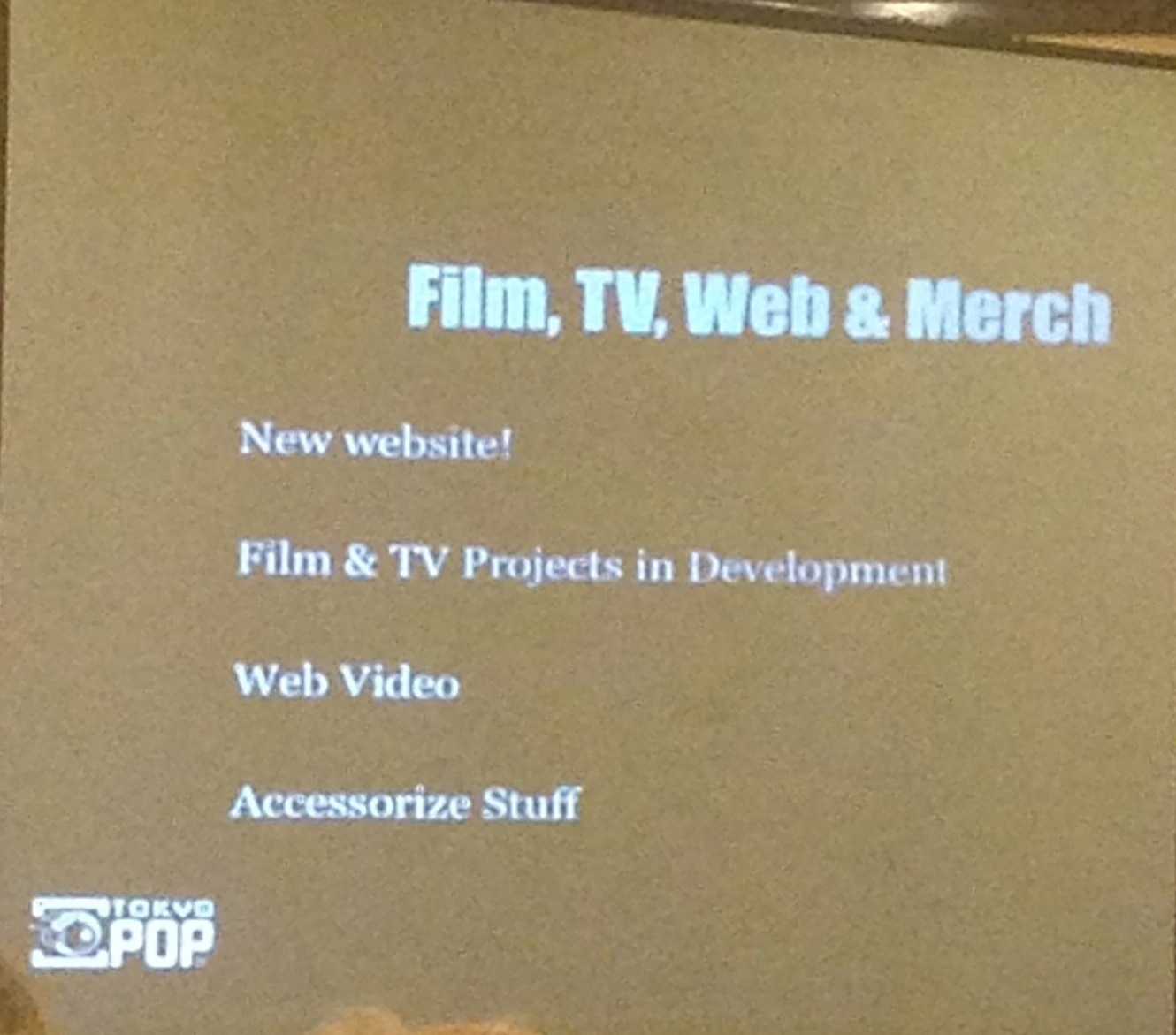
They also discussed a couple other things they were working on (some already mentioned above).
20130216-142439.jpg

They’re offering merchandise through CafePress. There’s a small boutique of items at the moment, but mentioned that they’d be happy if fans sent in any ideas for new items.

Film and TV projects would most likely be OEL, though they do have those rights for a very few Japanese series. Stu acknowledged that OEL titles mostly didn’t sell very well, but he said that film companies and TV networks saw story potential in some of them (he didn’t provide any specific titles).

And that was pretty much it for the presentation. After that they went to trivia for prizes and Q&A, but I had to leave at that point.
AnimeLA con report part 2 – Funimation panels

I believe I’ve heard it said that one sign of a good con is how many different places you’d like to be at the same time throughout. By this measure, AnimeLA was pretty good: I often wanted to be in at least two places at once. So even though Funimation representative Sully held maybe 5 panels over the weekend I only made it to parts of 2 of them:

Funi industry panel (on Friday)
This was a pretty straightforward industry panel of the kind you’d read about at Anime Expo – talk up the company, show some trailers, talk about upcoming releases, Q&A as time permits. Points that stood out to me:

  • Kamisama Kiss is Funi’s most popular streaming title ever
  • Funi app in development for new Samsung TVs.
  • Funi is getting original Black Lagoon dub cast together for Roberta’s Blood Trail
  • Lupin III: The Woman Called Fujiko Mine release due “before the end of the year”, featuring Sonny Strait as Lupin. No mention was made of other dub casting for the show.
  • Tenchi War on Geminar (aka Issekai no Seikishi Monogatari aka Saint Knight) probably out before summer
  • One Piece Strong World due out this year, per #AnimeLA FUNimation panel.

Funimation Town Hall (on Sunday)
This panel was a little more behind the scenes in terms of Funimation’s process, business philosophy, numbers, etc. – it didn’t seem designed to provide information for any press in attendance so much as to help fans get a sense for how things work (and so Funi could hear about fans’ concerns). Of course, all this was done in a fairly high-level and diplomatic no-names-will-be-named way. Here’s what I got out of it

  • On Fansubbers: “Even now, a lot of fansubbers aren’t breaking the law” – meaning that w/o a US licensor, only the Japanese can go after fansubbers, so it’s (effectively?) legal. The upshot of this is that Funimation tries to announce their licenses ASAP so they can keep fansubs for a show from getting entrenched.
  • Working with rights holders: Chaos;Head took a long time to release – that was apparently due to a horrific art approval process. Funimation’s philosophy is that they want to maintain a good relationship with rights-holders, so they’ll never jump the gun; if they license a show and are told to sit on it, they’ll do so indefinitely – they said something about always seeking permission rather than forgiveness, and how if told to jump they’d ask “how high?”. Funi views these good relationships as key to the reason they’re still around and some other anime companies aren’t
  • Workflow: Funimation is transitioning to getting more of their material digitally on hard drives and in native HD. Apparently upscaling SD video can cost months (because of quality check iterations? They didn’t explain how that worked). I noticed that even getting materials digitally still seemed to involve moving physical drives around rather than just setting up some sort of file transfer. Sully also mentioned that the dubbing process itself is about 60% of the production time for a show.
  • Releases: “Physical media is going to remain a large part of our business paradigm for a long time to come.” Funimation mentioned that they try not to release anything on HD unless it looks markedly different than on SD, so if they don’t have High Def materials they’ll only upscale the SD stuff if they’re high enough quality to support the upscale. Some shows aren’t – they were shocked that FLCL was worth upscaling. They’re also aware of issues with their streaming services, and are working out kinks with the Roku app in particular; they’re also in the middle of refactor ALL the Funimation apps (including funimation.com
  • Outreach: “Both Trigun and Summer Wars did very well theatrically” (meaning that they were profitable – Funi’s theatrical runs are usually more promotional than directly profit-oriented). As far as con support goes, they have a program called No Cons Left Behind, but even so the proliferation of conventions with 1000+ attendees is challenging to support – when Funi started trying to support cons they were looking at a few hundred of them nationwide, and now they’re apparently dealing with thousands (I’m not sure if I heard this correctly). Sully indicated that she’d personally attended something like 37 cons in the last year. She also said that Funimation hoped to be back at AnimeLA next year (2014).

AnimeLA 9 con report part 1

Anime director Masaaki YUASA was at AnimeLA on Saturday as an industry guest and the highlight of a couple panels. Since a lot of folks can’t exactly make it out to Los Angeles immediately after New Year’s for a mid-size con, I figured I might as well write up what little I could remember of his panels. It’s worth noting that Yuasa-san was in town around this time for the dub recording for his crowd-funded short Kick-Heart and that his ability to be at the con was more of a happy coincidence.

His first panel of the night was Anime Production in Japan. Other guest were Eunyoung CHOI (color coordinator and an animator on Kick-Heart), and Maki TERASHIMA-FURUTA, Vice President of Production IG, LLC (Production IG’s US branch). The panel itself was mostly a Q&A session after a few initial announcements – that Yuasa-san was at AnimeLA on Saturday only, but that he was in the US through next Saturday, and that IG hoped to bring him to the US for another convention this year (they weren’t ready to announce which one just yet, though after the panel Maki did seem to spend a fair amount of time talking to SPJA CEO Marc Perez, so perhaps Anime Expo is under consideration).

  • The goal was to have the Kick-Heart premiere for backers be the world premiere (meaning among other things that it hasn’t premiered in Japan yet)
  • On animation production (not a big part of this panel, despite the title): some amount of animation work in Japan is done by people working from their home rather than in the studio, but they collaborate by mailing around pieces of paper and the like rather than by emailing files
  • Yuasa-san said that as a child he was inspired by shows like Yamato and Mazinger Z and Castle of Cagliostro. He wanted to be an animator even as a child, and can’t imagine what he’d want to do if he hadn’t become one.

The panel was well-attended: with perhaps 37 of 45 seats filled. At the end of the panel Yuasa-san signed some autographs and drew a few sketches (though this had to be cut short due to time limitations), but he did manage to get his picture taken with some of the Kaiba cosplayers in attendance:

20130127-014304.jpg

Yuasa-san’s second panel of the night was Kick-Heart Crowd Funded Anime

20130127-011538.jpg
left to right in my poor-quality photo above: Stephen Weese, Maki TERASHIMA-FURUTA, Eunyoung CHOI, Masaaki YUASA, Richard Epcar, Ellyn Stern. Also sort of in the photo in the front row are some of the backers who were selected to be in the fan dub, though you probably can’t identify the back of their heads…

This panel was more panelist-driven, with the discussion largely driven by Richard and Steve (who worked on the dub along with Epcar Productions). I apologize that my notes from the panel are so fragmentary, but here’s what I remember:

  • Paypal pledges to Kick-Heart after the Kickstarter closed are still coming in even as of the time of the panel; the total amount of money raised at that point was about $230-250K
  • One of the issues encountered with Japanese backers interested in backing the project is that they aren’t used to entering their credit card information for online orders (I understand they often use some other form of payment for ecommerce). Kickstarter requires credit cards through Amazon, but Paypal doesn’t so it seems like Japanese backers were more likely to pledge via Paypal than through Kickstarter.
  • From what Maki said, it sounds like the 10-minute Kick-Heart film (now 12 minutes) was originally intended as a trailer to raise money for a feature-length film. This might explain why early stretch goals for the project had held out the possibility of extending the film to 40 minutes or even a feature-length production if enough money could be raised.
  • Asked about what creative freedom crowd-funding provides, Yuasa-san said that it didn’t alter any decisions he would have made; it just made it possible to produce an animated short film, which is quite hard to do in Japan these days.
  • Richard asked Yuasa-san if he got the idea for Kick-Heart by being a fan of pro-wrestling…or perhaps of masochism? Yuasa-san said that as a child he watched and was a fan of Tiger Mask, and that although he isn’t personally interested in S&M it fascinates him as an idea.