
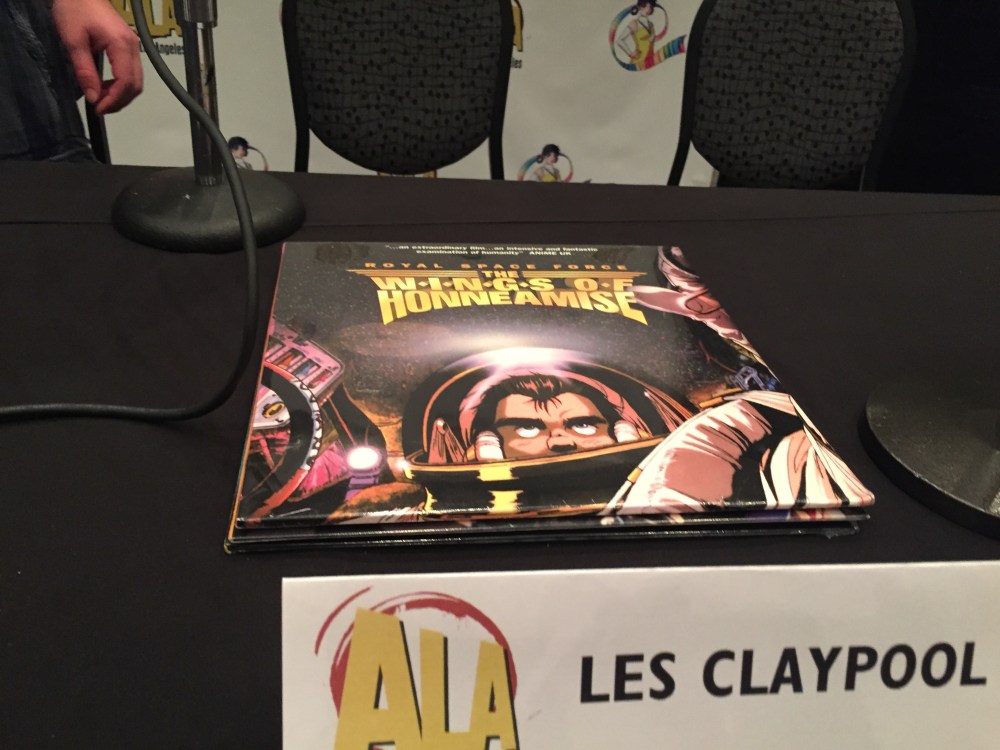
The following are my notes on the panel. I cleaned up the prose a bit, but this is still more in the form of notes than a proper article or blog post.
The following are my notes on the panel. I cleaned up the prose a bit, but this is still more in the form of notes than a proper article or blog post.
Pacific Media Expo 2015’s anime guest of honor was Kyoko Hikami, a voice actress likely best known for her role as Momoko/Wedding Peach in the anime adaptation of Wedding Peach, or perhaps as the rabbit-ear-and-dice-wearing Rabi-en-Rose from Di Gi Charat. She held two panels at PMX, as well as at least one autograph session. PMX is small enough that neither was especially crowded – the panel I made it to peaked at about 20 attendees, and the line for autographs was similarly short. Continue reading
Silencer is a plain-looking dagger, a bit on the short side but otherwise apparently remarkable save that it produces no sound when it strikes something. When a creature is damaged by Silencer, they must save to avoid being affected by Silence (though the effect applies only to that creature and does not radiate out from them); if the creature is surprised by the blow (as with a sneak attack) they save at a disadvantage.
If Silencer is used to strike the killing blow against a creature, that creature cannot respond to Speak with Dead or similar affects (the creature can be contacted and even be present, but it cannot in any way respond), and if such an unfortunate is returned from the dead they will be mute, an effect that can be cured by only by Regenerate or effects of a similar power.
These are my notes from a panel I attended at Fanime 2015. The speaker was Nick Rowe from Dr. Comics and Mr. Games.
This is from the Kleckbait episode – the annual interview with RightStuf founder and owner Shawne Kleckner. The format I’m using here is a number or number range indicating about how many minutes into the episode relevant comments are made, along with a summary of what’s said. As usual, I’m not attempting to transcribe or even roughly summarize everything said – just trying to pull out data and factoids.
Sorcerers were introduced to D&D in 3rd edition. At the time they could be best described as “Wizards, except they use Charisma instead of Intelligence, and they use spell slots to dynamically cast spells from a small static pool, rather than casting from from pre-defined loadout of spells from an indefinitely large pool”. Oh, there was some noise about where they got their apparently-innate magical ability – something about possibly being descended from dragons – but if so that didn’t seem to make any difference to their abilities – they were still learning and casting the exact same set of spells as Wizards.
While at Fanime this Memorial Day weekend I realized that though I attend a number of anime conventions and I buy quite a bit of anime on DVD and Blu-ray (my DVD library software lists about 1900 SKUs, though a few of them aren’t anime…), I buy very little anime at conventions. For example, at Fanime the majority of the anime I purchased was at the swap meet; I think I only made a single retail purchase. But I don’t exactly avoid spending money at conventions…
The obvious reason for this is the internet – online shopping for anime just about as convenient as buying at-con (you might think walking away with discs in hand is more convenient, but I argue that only makes a difference if you plan to go home or back to your hotel room and try watching what you bought in the next day or two). Also, online anime tends to be cheaper – convention dealers like Anime Pavilion basically offer a flat 25% off MSRP for all anime, while online you can usually get discounts of 25%-40% on non-clearance titles – for example, Rightstuf offers 40% discounts on preordered titles. Except if they’re from NIS America, Aniplex, and (now) Pony Canyon USA – then the discount tops out at 20% – which means it’s worth buying those titles at a convention.
That leads me to wonder when it is worth buying anime at a convention rather than waiting to get it online. Here are the circumstances I’ve thought of so far:
Any other ideas about when it’s worth buying anime at cons?
A certain tokusatsu panelist couldn’t make it, so Gainax co-founder Hiroyuki Yamaga agreed to run a panel on Gainax’s pre-production film Uru in Blue. I took some rough notes – this won’t be a write-up of the panel so much as a transcription. Also, both the notes and the photos were taken on my phone; please set your expectations accordingly.
Some background: Uru in Blue (Japanese title: Aoki Uru) is a film project by Studio Gainax. Fans in and out of Japan have been seeing information about it since the 90s – Carl Horn ran a panel about it at Anime Los Angeles earlier this year. Carl also attended this panel, so if he runs his Aoki Uru panel again there’s a chance it’ll be updated with some of what what revealed here.
I guess I need to start with a statement of purpose? Anime News Network has a podcast (ANNCast), which sometimes lets slip bits of industry information that we as fans don’t otherwise hear – sales numbers, business processes, sometimes even gossip. My goal is to try to collect these tidbits, summarize them, and provide some kind of citation for each one. I expect it to start kind of rough…
 Percent Liar