
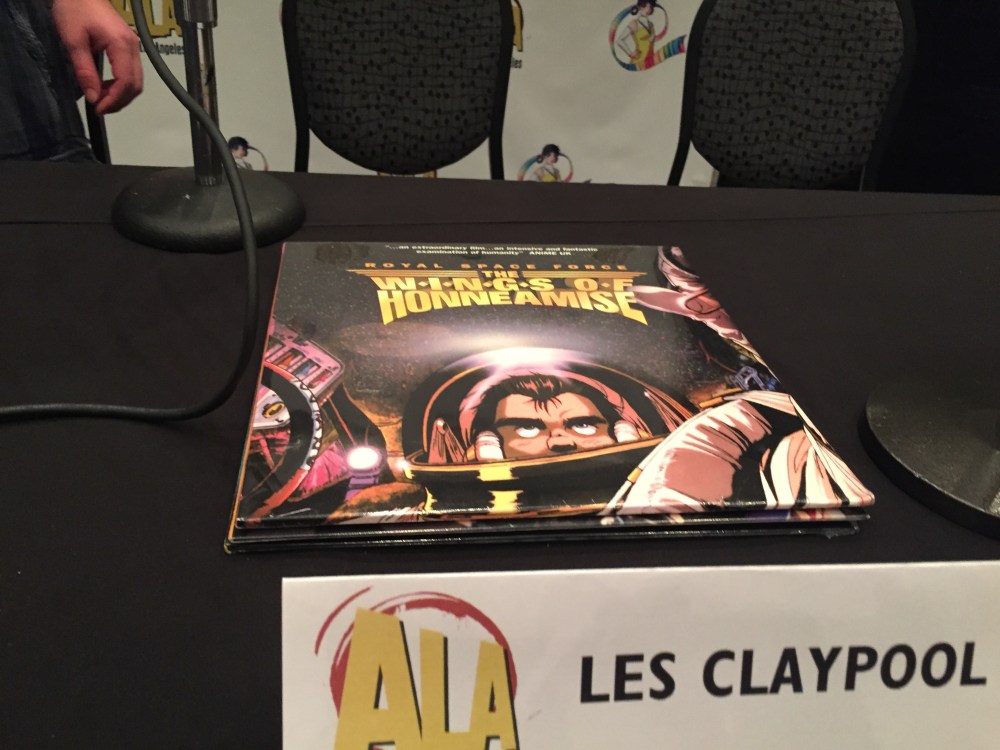
The following are my notes on the panel. I cleaned up the prose a bit, but this is still more in the form of notes than a proper article or blog post.
Introduction
Les Claypool III (not the Primus guy). Did new recording/fixes to recording of Street Fighter for Discotek. Has worked on titles such as Akira, Trigun, Macross Plus, Big O, Ghost in the Shell…His wife wrote all of GitS TV adaptation – she couldn’t be at the panel tonight due to another writing job. (However, their daughter was present.)
History
His 3 passions “since birth”: martial arts, music, and movies. The more can be put together in a single thing, the happier he is.
Got into Super8 film-making at a young age with a friend; they made “1-reeler” films since they could only afford 1 reel of Super8 film at a time
Later, as an adult with a day job he reconnected with this friend. His friend was now in the FX industry and had access to props from movies like Evil Dead 2 – for example, they were able to use the cabin from Evil Dead 2. They decided to make a kung fu movie together as sort of a passion project. However, at one point they realized there were no asian people in their kung fu film. Claypool’s friend had some connections via (Rick?) Baker’s company, and managed to pull in Johnny Psycho and Steve Wang.
The movie was never finished – at one point Les realized he’d basically lost the whole crew (while holding a light with one hand, using foot to pump fake blood for a scene while he pointed camera with the other hand)…but he ended up helping Steven Wang with his 2-hour Super8 film Kung Fu Rascals.
The audio post-production process for Kung Fu Rascals consisted of Les & Steve going basically 24/7 in Claypool’s mother’s garage. For this level of work Steve covered Claypool’s food and bills for the duration of the work. There was no actual pay as such, and Les wasn’t saving, so when the movie was completed he needed money again. He tried to get back the day job he’d taken a leave of absence from, but they said sales were down and couldn’t hire him again until sales were back up (though he could always come work for them for free in order to get sales back up to the point where they could hire him again…). Since this didn’t solve his problem of needing money, Les got ready to seek unemployment.
This wasn’t the best timing: Les was left looking to apply for unemployment on a holiday, when he couldn’t even get started (and didn’t have the first idea how to apply for unemployment either). While he was trying to figure that out he got a call from Steve’s friend Ken. Ken was calling from “The Cave”, which was actually a dirt cave below a house in Ventura. This was actually where some of the earliest anime dub work was recorded (reference the Anime World Order episode with Steve Blum, I think…)
Ken & company were desperate, so they said they’d go straight to Les’ house. When they arrived it wasn’t just one or two people: in walked Kevin Seymour, Ken Iyadomi, Bob Napton, (another early US Renditions person whose name I missed), and Ray Garcia. They started asking questions immediately to figure out if they could use Les’s setup for recording, since they were having a lot of problems with their current setup. For example, The Cave had no equipment so Ken and his folks had to carry all the equipment uphill to the house, and then down into The Cave itself for every recording session. This was the LA Hero/US Renditions era of anime localization – nobody knew anything about dubbing. This led to what could have been a show-stopping question: how many microphones did Les have?
Les brought in the one (1) microphone he had at the time – the one Steve Wang had bought him. Since Les only had the one mike, he asked why the number he had was important. It turned out the way LA Hero handled dubbing was to call in all their actors for an episode and have them hang out in the booth, walking up to the microphone in turn to record their lines. Essentially, this meant 8-hour days for each of them even if they only had a couple of lines. Les suggesting individual ADR recording rather than this Japanese group-style recording sessions, and apparently this was something that hadn’t occurred to any of the LA Hero folks – Ken thought it was a great idea. But they had to discuss it before they could decide so they left the house.
Les got the call 3 minutes later: they wanted to start the next day. Ken Iyadomi apologized for being able to pay Les “only” $550/day – at Claypool’s day job he’d been making only $500/*week*, and that with a commute; Les replied that he figured he could deal with $550/day as a starting rate.
Early dubbing work was all done in Les’s garage, cluelessly and by the seat of his pants.


It was also done with minimal equipment (photos above show his original tape deck, controller, and microphone), but later he had to relocate to other facilities and kept growing, eventually to 3 locations. Les (and later his other staff as well) were always connected to Japanese staff via Ken Iyadomi, so they could send questions back to artists. This meant they always felt a sense of connection to and respect for the creators and what they had made – it wasn’t just some pre-existing product they felt they could change. Les and Magnitude 8 tended to face more arguments from American producers than from Japanese producers.
Early days actors included
- Fahns (?)
- Steve Blum – at first he didn’t even think of himself as a voice actor, and it sounds like he had to be talked into really giving it a shot. They all found out how good he was on Giant Robo – the project was so secretive they wouldn’t be told anything from Japan about where the story was going (in a departure from their normal ability to get information from creative staff in Japan), who was going to live or die, etc. Blum could do several distinct voices, so he had ended up cast in multiple parts. This multiple casting worked out in such a way that a significant portion of the 2nd half of Giant Robo was one Steve Blum character talking to another, and even having an 8-minute argument back and forth – which Steve was able to pull off.
- Steve Castling(?) – a major presence on the Orguss dub. He’d built his own small plane (an ultralight?), and would fly it down from his home in Big Bear for recording sessions. He was apparently pretty good at taking things in stride – at one point Steve needed to dub in a death scream. Steve asked Ray Garcia for some context, and Ray sort of geeked out and filled Steve in on everything about Orguss. EVERYTHING. At the end of all that Steve’s response was “I don’t think I needed all that for a death scream.”
- Bryan Cranston – yes, from Breaking Bad. Les’s wife had to chase Bryan out of her office multiple times for snooping on her computer just to kill time while waiting for his sessions to start.
- David Hayter – yes, Solid Snake
- Mike Forrest – yes, Apollo from the original Star Trek. Back around this time, Les was doing well (at least compared to the actors), so he’d lay out a big spread for them; some of them would take a couple passes at it (perhaps a sign they weren’t getting much work at that point…). Mike in particular was a Corn Nut fiend; you couldn’t feed him enough. One day Les knew Mike was coming in, so he’d taped packages of corn nuts around the edges of the studio TV. At one point in the recording Mike noticed, and stopped the recording session so he could come out of the booth and remove each package that was taped to the TV.
There was a limited amount of foley recording done by Magnitude 8. Claypool’s landlord had a (very expensive and very heavy) 4’ x 4’ unit for just this sort of recording work; it was dubbed “The Refrigerator” by all who had to work in it. The landlord had acquired it from the Financial News Network when they went out of business…
Akira was a noisy 4-track mix from the 80s. Everything on the track – background noises and all – was doubled. The back channel was previously mono; Les brought it up to stereo. His work on Akira resulted in one of the strangest reviews he’s ever gotten: “best use of silence I’ve ever heard”. This was based on a scene in the movie that was meant to be silent – but the track as they received it was noisy. Les was able to process the entire mix with a full, totally digital process – this allowed him to bring the silent scene down to “digital black”; at the time the mix was being put together, this involved dragging down *banks* of sliders at once to pull the entire signal down to 0. This was Les being experimental, but at the movie premiere he worried if he might have overdone it – when the scene came up, everyone who’d been eating their popcorn stopped, and it seemed like the audience might be confused; after all, the sound had cut off *completely*, even though the picture kept moving.
The true story of Macross Plus episode 4
Magnitude 8 had previously dubbed Macross II. Some time later they worked on Macross Plus, and completed dubbing of episodes 1-3 without incident. However, at the time episode 4 arrived Manga Entertainment had just managed to get into a rights dispute with Japan. Magnitude 8 was told that they “can’t contractually use audio from episode 4,” and were asked “how quickly can you re-create M&E [music and effects]?” Manga was hoping they could pull M&E from bits and pieces of earlier episodes.
Magnitude 8 ended having to record Macross Plus episode 4 from scratch – that is, their audio starting point was silence. This was after they’d already done a dub using audio from Japan. They not only had to re-record dialogue, they also had to re-write the script! Les managed to make all this work, but there was one thing he hadn’t counted on: Shoji Kawamori would be coming by the studio for another project he was involved in, and Les would have to show him their work on Macross Plus episode 4….
Around this time Les’s wife was in Japan for Ghost in the Shell (the movie). While there she’d purchased some laserdiscs including the episode in question, (which she might have lost, dropping behind a booth while at a drinking party after work in Japan, but everyone scrambled to help move the booth and dig out the disc and a nu
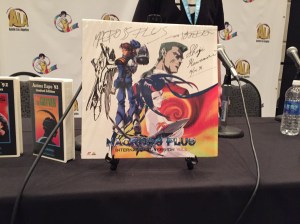
mber of other things that had ended up back there over the years…). When Kawamori was at Les’s studio he did in fact get to hear the re-cut; his only comment was something like “Ah~. Hollywood style!” He must not have minded too much – he signed Les’s LD of episode 4. Incidentally, while visiting America Kawamori was missing his young daughter back home; he spent a lot of time crawling around on the floor playing with Les’s baby daughter during his visit.
Influence of Kevin Seymour
Everyone thought Kevin was weird, but his trick was that he’d find the ways in which *you* were weird, then he’d turn out to already have stuff related to that in his collection, and things from his collection would start showing up. Basically, you could be a freak about anything, but Kevin was a freak about everything.
Early on, Magnitude 8 was recording a number of shows in which people were talking while wearing helmets, but they didn’t have any obvious way of creating an effect to reflect this for the dub. Les solved this by “borrowing” a Tupperware container from his mother (he still hasn’t returned it after all these decades – in fact, he brought *it* to the panel as well, though I regrettably didn’t get any pictures of it); you’d hold it next to your face and talk into it just a bit and get an effect that sounded about right. Not right enough for Kevin, apparently – he brought in various helmets with holes in them, other containers to create similar effects…for Black Jack he brought in collections of different types of medical masks.
Ken Iyadomi would be “helpful” in a different sort of way; he would for example order pizza for staff without bothering to ask what they’d want on the pizza. As a result they’d end up facing a gift pizza covered in jalapeños. This wasn’t a problem as far as Ken was concerned: “Just take them off.” According to Les, most of Ken’s communication was like that: 5 words or less (and heavily accented despite years of living in America).
An attendee asked Les about working on the Ghost in the Shell movie. Les talked about how that movie’s Japanese track had been subjected to “processing roulette”, in which the processing applied to dialogue was apparently random rather than correlated to the way people were communicating – speaking in person, talking over radio, communicating via mindlink, etc. In order to straighten this out for the dub Kevin and Les spent 16 hours over 1 weekend repeatedly watching the movie to document how each type of communication was taking place and figure out a consistent form of processing for each. Les said that was Kevin’s level of obsession – he was just along for the ride.
Current projects
In 2015 Les was only working on two anime projects:
- The restoration of Castle of Cagliostro audio, since he had all the original materials and nobody else did), and
- The cleanup of audio for Discotek’s re-release of the Street Fighter movie on DVD and Blu-ray, merging the (new?) English dub with the original Japanese music track (yes, including the song CRY from Isamu Teshima’s Self Selection during the Chun Li/Vega fight). Les played a brief sample of the movie and of that scene in particular – he was running short on time, so he couldn’t do the before-and-after comparison he’d planned, nor go into much detail about the 2000 audio fixes that are going into this new release.


 Percent Liar