
A certain tokusatsu panelist couldn’t make it, so Gainax co-founder Hiroyuki Yamaga agreed to run a panel on Gainax’s pre-production film Uru in Blue. I took some rough notes – this won’t be a write-up of the panel so much as a transcription. Also, both the notes and the photos were taken on my phone; please set your expectations accordingly.
Some background: Uru in Blue (Japanese title: Aoki Uru) is a film project by Studio Gainax. Fans in and out of Japan have been seeing information about it since the 90s – Carl Horn ran a panel about it at Anime Los Angeles earlier this year. Carl also attended this panel, so if he runs his Aoki Uru panel again there’s a chance it’ll be updated with some of what what revealed here.
Yamaga said that folks at Gainax have been working on Aoki Uru for an incredibly long time – the history of the project may go back further than Fanime, though production only really got going recently. They’d previously had production underway around 1992-93, but it had to be cancelled because a number of Gainax folks started working on some “Eva” thing (for example, the concept image below was drawn by Yoshiyuki Sadamoto around that 92-93 period; almost immediately afterwards he went on to become the character designer on Evangelion). Basically, Eva’s popularity put Uru on pause until now.
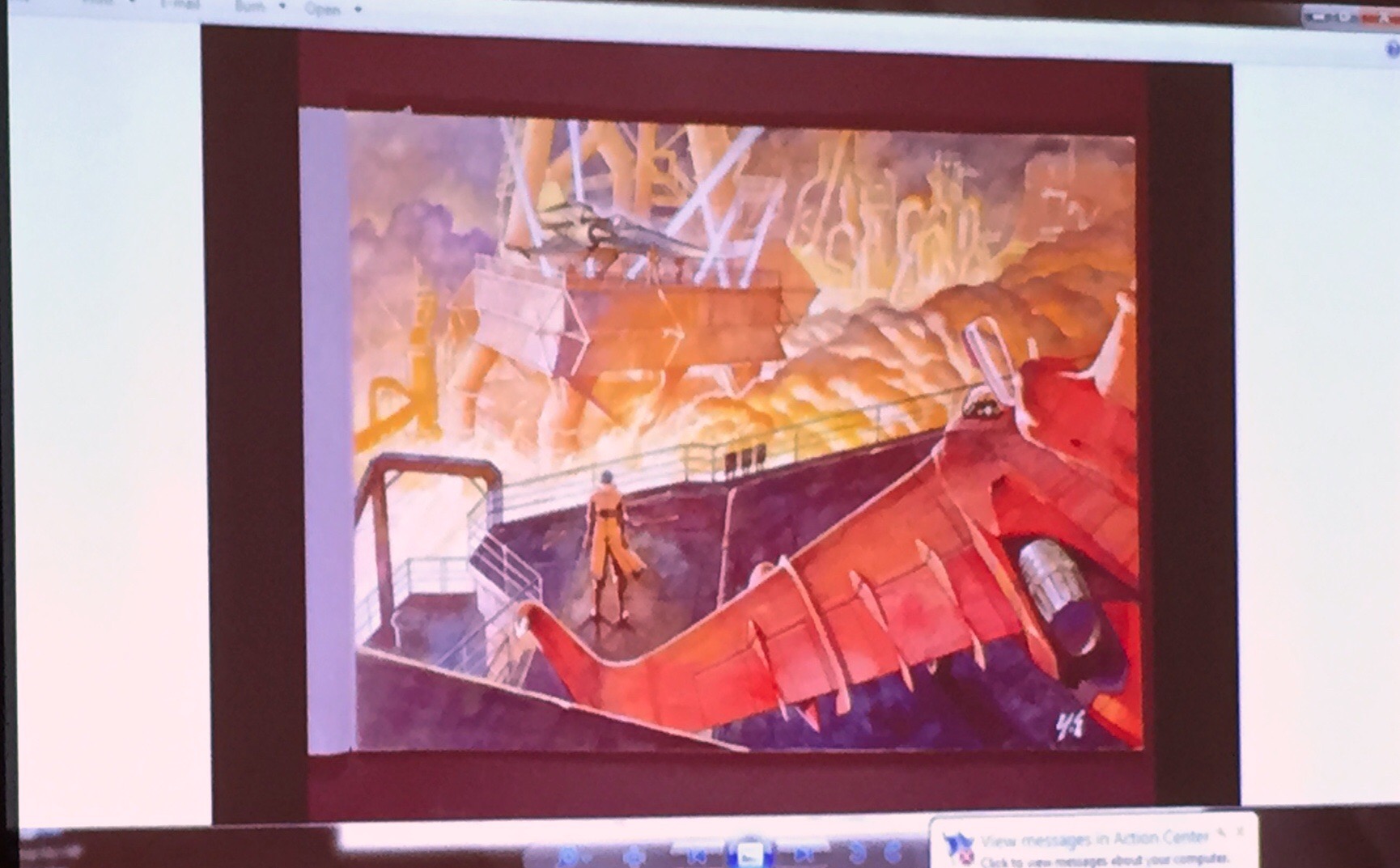
Aside: all art shown (except possibly the Sadamoto piece above) are from the rebooted project. Mecha design for the protagonist’s jet is by Masamune Shirow (yes, that Shirow – the one who created Ghost in the Shell. Apparently he still does some work aside from porn…). Storyboards such as the one below were drawn by Yamaga. Yamaga is also working with Sadamoto to refine character designs.
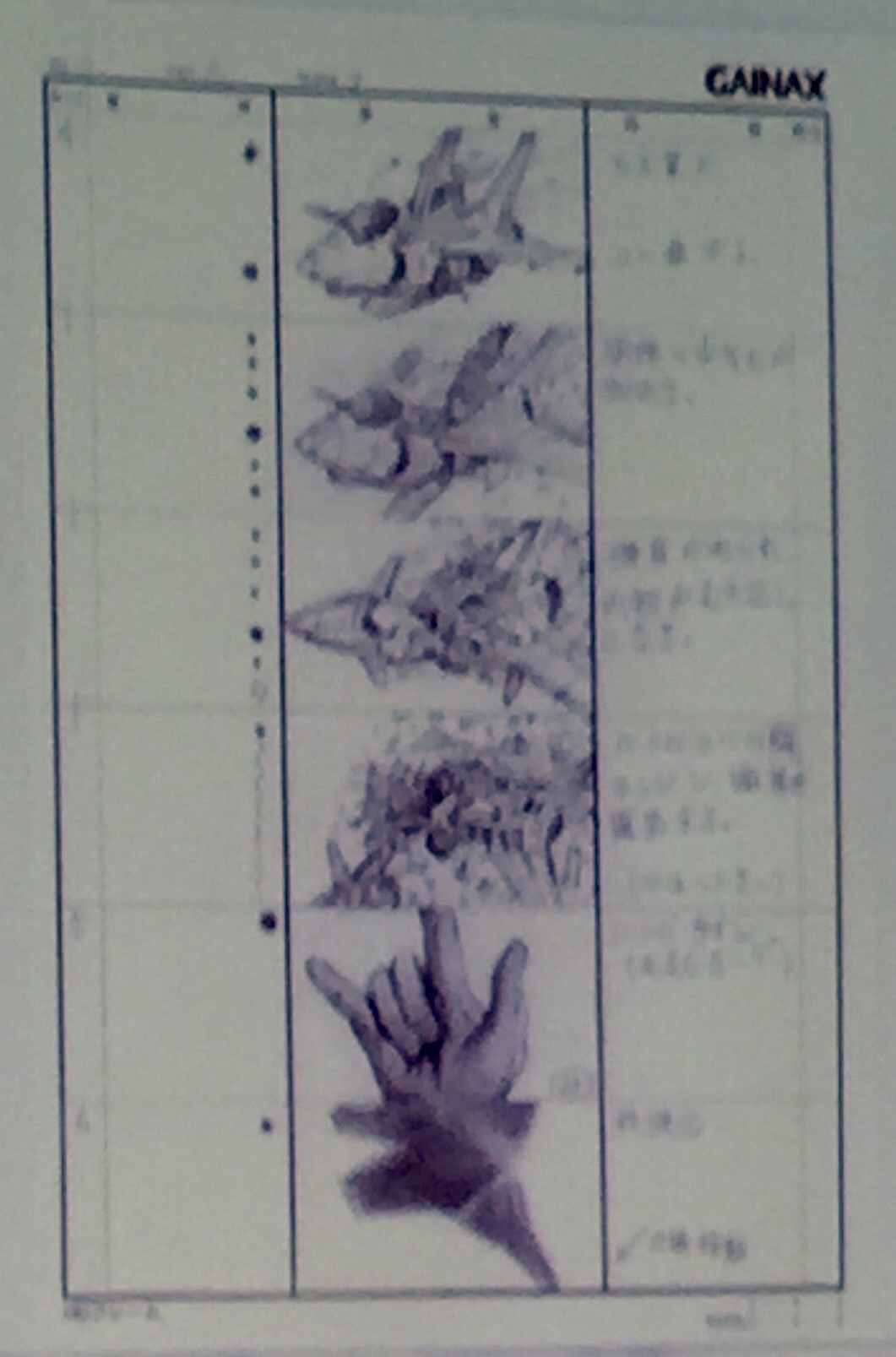
Yamaga’s plan for the project is to start by making a 6-minute short film entitled “Overture”, with the aim of getting all the staff on the same page creatively (if I understood what was said correctly, the short would also be used to promote the film). In particular, Mr. Yamaga is conscious of how in his 30s he was focused on the story he personally wanted to tell, but these days he’s more intent on the film the whole team will make.
Setting
Uru will be set on the same world as Royal Space Force (aka Wings of Honneamise), a planet other than Earth but which is technologically comparable. Uru is set 50 years after the events of Honneamise and in a completely different nation. This means that while it’s intended as a sequel to Honneamise, the characters from that film won’t be featured though they may make cameos.
The nation in question is very peaceful, but there’s a strong tradition of dueling that originated with a knightly class. Excessive dueling diminished or eliminated most knights, leaving only the rights associated with the knightly positions. Now organized crime groups buy up these rights and hold duels more as a gladiatorial fight/gambling sport. Characters are therefore these thuggish down-on-their-luck pilot duelist “Knights”, and dueling is a sort of underground phenomenon – it isn’t broadly accepted by society.
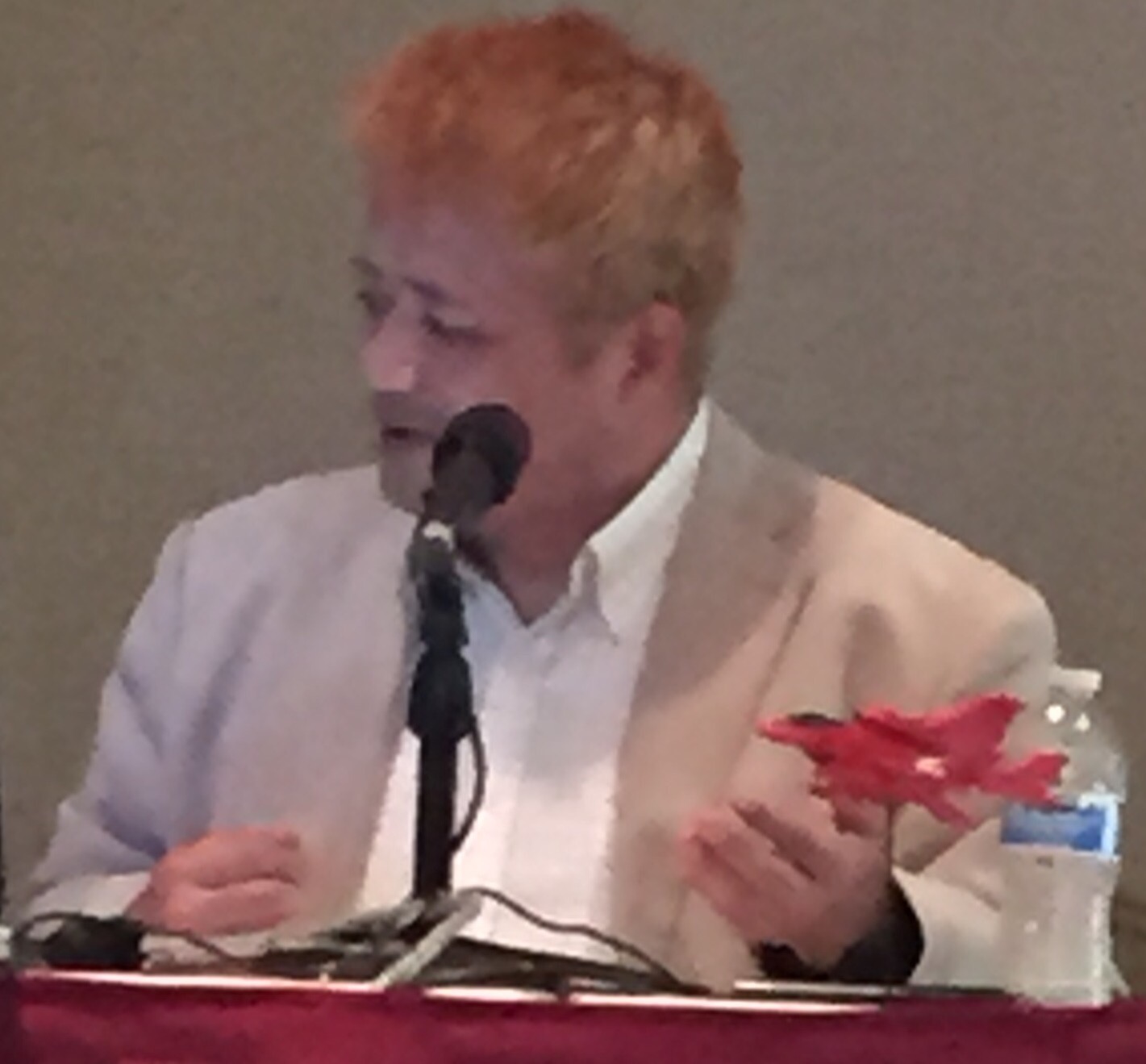
The jet model on the desk in front of Yamaga is what’s used in duels. Although it looks futuristic, it’s based on modern technology (I understood this to mean the jets don’t have magic capabilities that surpass those of Earth technology). These jets are bought from the military and refitted for dueling – that’s why the one pictured below is bright red. There is one modern jet feature that’s missing from these dueling planes: ejection seats. Because duelists don’t have the option to eject, the loser of a duel is likely to be killed, but even so duelists fight for “honor”/glory/renown. Most don’t live past their 20s.
Duels aren’t restricted to plane fights; sword duels, fisticuffs, and other forms of battle are also possible, however the duel sponsors favor the plane fights. The protagonist’s sword comes from when he slew an opponent at age 14 and claimed the opponent’s sword as a traditional symbol of victory over the opponent – the sword represents the knight. The robes shown in some designs are considered unusual and antiquated.
Characters
No character names were mentioned, and Mr. Yamaga only really discussed the lead, who comes from a desert town and was raised to be like a knight for his people. He’s very skilled in combat – having managed to keep winning plane duels and survived to age 32. Being reckless was fine when he was younger, but now he’s reached the age where he’s started to think about his life and has some issues he has to overcome or deal with…Yamaga said his concept of the lead has changed dramatically since 1992: the model for this character is the current-ear Japanese animator. These changes have resulted indirectly from the delay; in 1992 Yamaga was a man in his 30s trying to depict a lead also in his 30s, but now he’s in his 50s and has a different perspective on the protagonist.
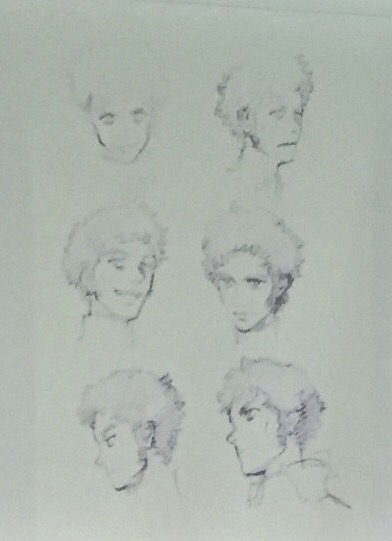
In terms of character design Yamaga wanted the lead to have a distinctive appearance, thus his hair and sword (the latter designed by Yamaga). Yamaga drew some further (for example, the dueling opponent) maybe 2 days before Fanime and is still unsure about the design. The (currently-long-haired) is sort of the opposite of the protagonist, having grown up rich.
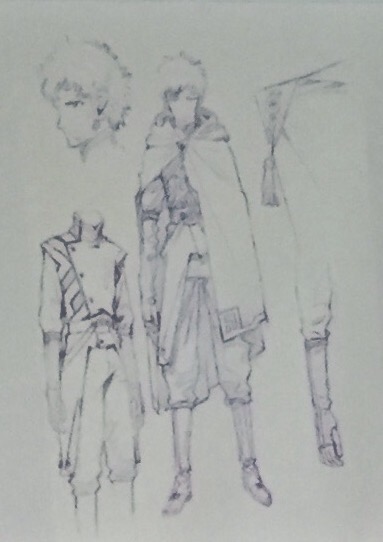

The plot revolves around the protagonist going to a NY-size city for work where he meets a girl and falls in love. Back in 1992 Yamaga wrote 3 short novels covering the plot of the movie; even now he isn’t planning on changing the plot from those novels in making the movie, but the 3 that were released don’t tell the whole story – the novel series was originally planned to be 7 volumes long, then compiled. Yamaga stopped writing the novels (again, due to that whole “Eva” thing that delayed this production) and hasn’t published the 3 he has written. However, once the movie is produced he’d like to have a story or light novel for each knight.
I didn’t quite catch a question from an audience member about a claim that the plot of Uru was just a retread of Streets of Fire (probably a reference to this rumor). As I understand it, Mr. Yamaga said that rumor was a result of a misunderstanding – when Yasuhiro Takeda said he didn’t know how to produce a movie, Yamaga counseled him to think of his favorite movie (which was Streets of Fire) as a concrete example and imagine the steps that would be necessary to put that together. How this bit of advice would lead to such a misunderstanding I’m not certain.
Production Details
Currently the production team is focusing on finalizing designs and story, and producing the 6-minute short. When an audience member asked about who else was currently (or might possibly) be involved besides Yamaga and Sadamoto, Mr. Yamaga said that it was a little early for him to talk about that – he has contacted “certain individuals”, particularly designers as they need to design an entire city. However, he had no names to give us that we’d recognize. Yamaga is hoping he’ll have actual animation to show next year; for now all he could show was a final rapid-fire set of production sketches, though I didn’t get any photos of them.
We got some of the gorier details of production that I didn’t understand in full – something about forming “a secondary studio level B”, and starting on their 2nd round of funding. Traditional means of getting funding to produce anime have never been very formal and apparently working as well these days – at least, they just aren’t working for Uru in Blue. As a result Gainax is seeking funding from Singapore. This is a real learning experience for Yamaga, since he’s spending a lot of time learning to make contracts. This time last year he was just starting to write contracts, and right about now they’re ready to be submitted, with hopes to get them signed maybe this July to August.
As far back as 92 Yamaga planned to use (some) CG for Uru, but said he wants to keep the 2D animation and use CG to enhance rather than replace 2D. He feels that many studios misuse CG; one of the best strengths of JP animation being lines drawn by humans and their ability to communicate the artists’ passion to the audience. CG models can’t capture all the idiosyncrasies of hand drawings (bowing and bending, etc), but can try to match them. Yamaga feels the problem occurs when CG modelers decide the hand-drawn lines are wrong and “correct” them in their models – that passion, the “soul” of the animation is lost.
Mr. Yamaga said the best use of CG is for advantages that are hard to imitate in hand-drawn animation, such as some uses of lighting. The particular example he discussed was light refraction through a cockpit – the light should halo as the cockpit closes, but it’s ridiculously hard to try drawing that. Another application is when a light source is behind and shining down on subject being depicted.
 Percent Liar